

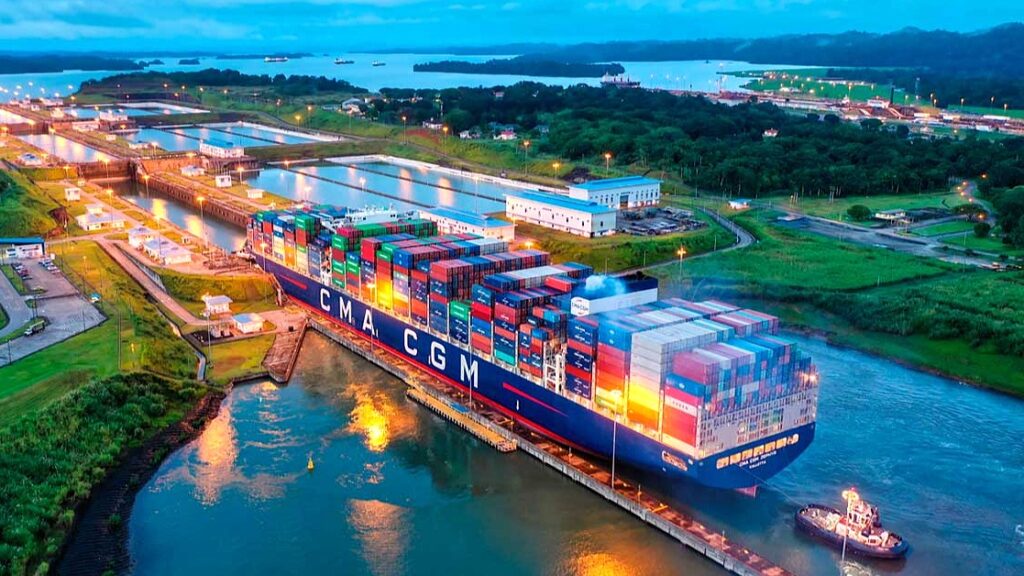
Panama Canal Administrator Ricaurte Vásquez Morales said the waterway’s sweeping $8.5 billion modernization program — which includes new port terminals, a gas pipeline, and a major water-reservoir project — is designed to keep the 110-year-old canal competitive as global trade patterns shift and climate pressures intensify.
In an interview with FreightWaves at the Houston International Maritime Conference, Vásquez explained that the Panama Canal Authority (ACP) is advancing plans for two new container terminals — Corozal on the Pacific side and Telfers on the Atlantic — which are expected to add between 5 million and 6 million TEUs of annual capacity and generate around 17,000 jobs.
“There is strong potential to increase throughput by at least five to six million containers per year over the remainder of this decade,” he said. “Existing terminal capacity is reaching its limit.”
The initiative, currently in a consultation phase with major industry stakeholders, forms part of a ten-year strategy to expand infrastructure while reducing reliance on water-intensive operations.
Vásquez noted that a soft-market sounding held in late October drew a “full house” of participants, including APM Terminals, DP World, PSA International, COSCO Shipping Ports, Maersk Line, MSC, and Terminal Investment Limited. One-on-one meetings with prospective partners are scheduled for early December, followed by a prequalification process in 2026 and the awarding of concessions in 2027.
“We had a full house,” Vásquez said. “Now we move to individual meetings. We want to listen and level the playing field, always guided by what is in Panama’s best long-term interest.”
He emphasized that governance will be “open and transparent,” and that the Canal’s solid financial position allows it to co-invest while preventing any single operator from becoming dominant. “We must remain open to all trades worldwide,” he added.
The Corozal and Telfers terminals are part of a three-pillar investment plan that also includes a $4 billion liquefied petroleum gas pipeline and the $1.2 billion Río Indio reservoir project.
The 47.2-mile (76-kilometer) pipeline would transport propane, butane, and ethane between the Atlantic and Pacific coasts, freeing up canal transit slots for other vessels without additional water consumption.
“We are dependent on rainfall,” Vásquez said. “That’s why we’re building a new lake. Some of these projects — terminals, gas lines, roads — are alternatives to move cargo, not ships, across the isthmus using technologies that do not rely on water.”
The Río Indio reservoir will be the first canal-related project built outside ACP-owned land and will require the resettlement of nearby communities — a process Vásquez stressed must be handled “carefully and transparently.”
The ACP estimates the new terminals will contribute between 0.4% and 0.8% of Panama’s GDP once operational. Vásquez underscored that the economic benefits will extend far beyond construction.
“The Panama Canal directly employs about 8,700 people, but roughly 150,000 jobs depend on it,” he said. “The spillover effect is significant. The key is ensuring those benefits reach local communities — and that is why governance is so critical.”
These developments come amid heightened U.S.–China tensions and a stalled $22.8 billion agreement for Hong Kong-based CK Hutchison Holdings to sell its Panama port assets to a consortium led by BlackRock and MSC.
Asked how the ACP balances foreign investment with national interests, Vásquez said neutrality is “embedded in the canal’s DNA.”
“We are working to reduce the risk of any single dominant player in the hinterland,” he said. “By treaty and by constitution, the Panama Canal must remain open to all trades.”
Despite changing trade flows driven by tariffs and nearshoring trends, Vásquez believes the canal’s strategic importance will endure.
“There will be some reshuffling, but not enough to diminish the relevance of the Panama Canal,” he said. “We must stay resilient, adaptable, and forward-looking. The market is volatile — our perspective is long term.”
As a leading marine ship supplier in Panama, OceanKida is committed to keeping our clients well-informed with up-to-date news and important developments in the maritime sector. We regularly share insights on regulatory updates, product innovations, and logistical improvements to support safe and efficient vessel operations. Our dedication to providing more than just supplies ensures that your maritime needs are met with expertise and timely information.