
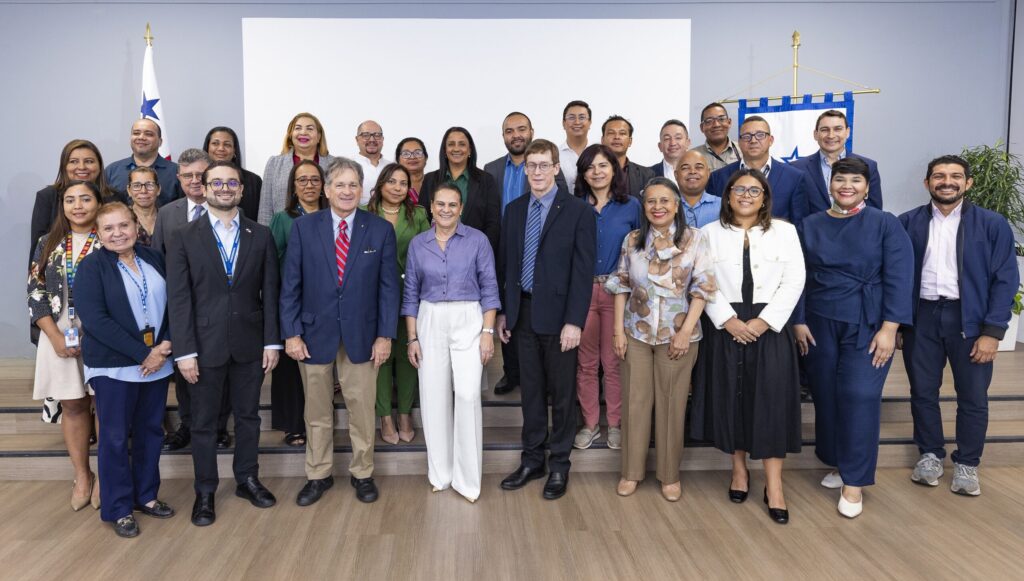
The Panama Canal and several Panamanian government institutions have established an Interinstitutional Coordination Committee for the Resettlement Action Plan associated with the Río Indio Lake Project. The committee will coordinate public-sector participation in the relocation process and in the restoration of livelihoods, helping ensure that commitments established in the Compensation Framework developed through dialogue with affected communities are properly implemented.
Because the resettlement process involves responsibilities across multiple public institutions, the committee will define the role of each agency and align their contributions with measures related to housing, income restoration, productive activities, social protection, environmental management, and community infrastructure. Led by the Panama Canal, the committee includes the ministries of Health, Social Development, Education, Environment, Housing and Territorial Planning, and Agricultural Development, as well as the Secretariat for Goals.
The initiative is also supported by Cabinet Resolution No. 91-25, which declared the Río Indio Lake Project to be of public interest and instructed government institutions to actively collaborate in its development. Panama Canal Administrator Ilya Espino de Marotta emphasized that resettlement should be approached as a human-centered process, with coordinated actions designed not only to relocate families but also to preserve their well-being, opportunities, and prospects for future development.
The Río Indio Lake Project is intended to strengthen Panama’s long-term water security, supporting more than two million people who depend on the Canal lake system for water while also helping ensure the sustainable operation of the interoceanic waterway. The project combines infrastructure development, environmental sustainability, responsible water management, and social development within the Río Indio watershed.
The planned reservoir will cover approximately 4,600 hectares, equivalent to about 8% of the Río Indio watershed, and is expected to require the resettlement of roughly 550 families living in 38 communities located within the project footprint. The newly established committee will periodically review schedules and commitments, identify issues requiring the participation of several institutions, and coordinate joint solutions as the project advances.
Each committee meeting will conclude with clearly defined actions, responsible institutions, and implementation deadlines that will be formally recorded for follow-up. The committee will not replace the legal responsibilities of participating agencies, community consultation processes, or individual agreements with affected families. Instead, it is intended to strengthen coordination, prevent gaps or duplication of efforts, and ensure that agreed measures are carried out effectively throughout the resettlement process.