


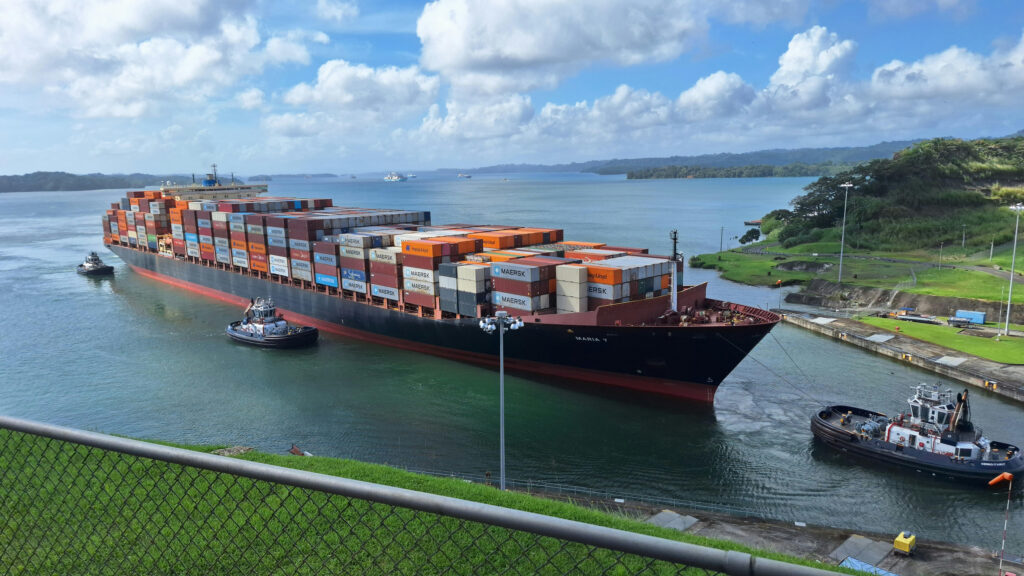
The Panama Canal reported stronger transit activity and higher cargo volumes during the first half of fiscal year 2026, reflecting growing demand for its services and the shifting dynamics of global maritime trade. According to the Panama Canal Authority, the waterway also saw increased use of its reservation system while continuing to operate efficiently and without congestion.
These updates were shared during a market briefing hosted by Anna Milne, Managing Director of Emerging Markets Corporate Research at Bank of America Merrill Lynch, with participation from Panama Canal Administrator Dr. Ricaurte Vásquez Morales, Deputy Administrator and Chief Sustainability Officer Ilya Espino de Marotta, and Vice President of Finance Víctor Vial. During the virtual session, Canal leadership presented first-half FY2026 results and provided updates on strategic initiatives including port development, a gas pipeline, a logistics corridor, and the Río Indio project.
Administrator Vásquez emphasized that the Canal remains fully open and reliable despite ongoing geopolitical uncertainty and evolving trade flows. He noted that favorable water levels are allowing the Canal to handle growing traffic volumes, while container cargo and liquefied petroleum gas (LPG) continue to be among the strongest-performing segments moving through the waterway.
During the first half of FY2026, covering October 2025 through March 2026, the Canal recorded 6,288 transits, an increase of 224 transits year-over-year. Over the same period, it handled 254 million PC/UMS tons, up from 243 million tons in the corresponding period of the previous fiscal year. Performance was especially strong in recent months, with daily averages reaching 34 vessels in January and 37 in March, while some peak days exceeded 40 transits.
On the issue of reservations and auction pricing, Vice President Víctor Vial explained that some auction slots have recently exceeded $1 million, but stressed that these figures reflect temporary market conditions driven by high demand. He noted that most vessels reserve in advance through systems such as LoTSA and the dedicated LNG booking system, which helps prevent queues and provides a more predictable transit schedule for customers. The Canal also continues to offer last-minute reservations and daily auction slots for vessels that do not secure bookings in advance.
The Canal also addressed water availability and drought preparedness during the briefing. Deputy Administrator Espino de Marotta said the ACP has been closely monitoring conditions since early in the year in anticipation of a possible El Niño event and has already implemented preventive water conservation measures. She added that unusually heavy rainfall during the dry season has kept Gatún and Alhajuela Lakes at maximum levels, supporting service continuity and helping the Canal prepare for the possibility of drier conditions later in the year.