


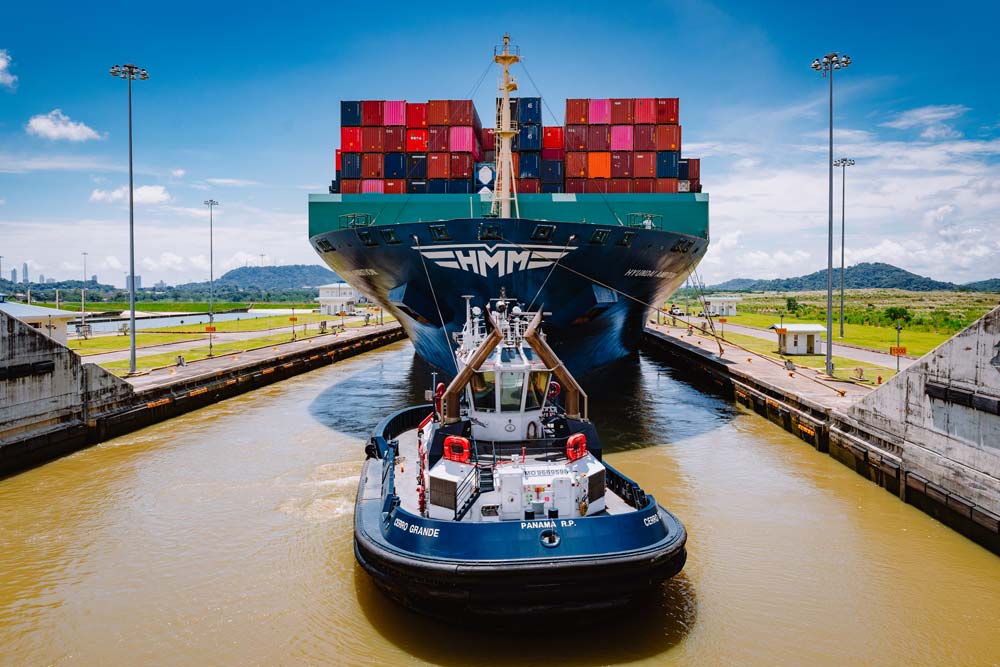
Preventive maintenance is one of the foundations of the Panama Canal’s operational reliability. Rather than waiting for equipment failures, the Panama Canal Authority follows a permanent and strategic program to inspect, preserve, modernize, and extend the service life of the thousands of assets required to keep the interoceanic route operating continuously.
Every safe vessel transit depends on an extensive infrastructure network that includes locks, gates, valves, hydraulic systems, navigation channels, dams, electrical installations, tugboats, land-based machinery, and other support facilities. Keeping these components available and functioning properly enables the Canal to continue providing safe, efficient, and dependable service to maritime customers worldwide.
The locks receive particular attention through dry-chamber operations, structural and electromechanical component replacements, gate maintenance, valve rehabilitation, and corrosion-protection work. These technically complex interventions require months of preparation and close coordination to minimize their effect on maritime operations. A recent dry-chamber project at the Pedro Miguel Locks, for example, was planned over six months and completed in five days during May, involving approximately 300 employees while vessel traffic continued through the available lane.
Maintenance also extends beyond the locks. The Panama Canal’s program includes dredging and sediment control within navigation channels, upkeep of its tugboat fleet and other floating and land-based equipment, inspections of electrical systems, and preservation of water-control infrastructure such as dams and spillways. Together, these activities provide the predictability required by Canal customers while protecting Panama’s competitiveness and the continuity of global trade.
The Authority also views maintenance as a platform for innovation and adaptation. According to Deputy Administrator Ilya Espino de Marotta, the Canal must continue evolving alongside changes in the maritime industry, ensuring that its infrastructure can respond safely and feasibly to customers’ future requirements. One example is the replacement of floating fenders at the Neopanamax Locks, which will support feasibility testing to determine whether vessels with beams of up to 53 meters could eventually be accommodated, compared with the current maximum of 51.25 meters.
Since the expanded Canal began operations, its capacity has exceeded initial expectations. Infrastructure originally projected to handle container ships of approximately 12,000 TEUs has successfully served vessels carrying more than 17,000 TEUs. Through continuous maintenance, modernization, and technical improvement, the Panama Canal aims to remain competitive and prepared for the operational, commercial, and climate-related challenges that will shape the future of global shipping.
Preventive maintenance therefore represents more than a technical responsibility. It is a long-term investment in the Canal’s safety, sustainability, resilience, and global leadership, helping ensure that the waterway remains a secure and reliable route for international maritime trade.