


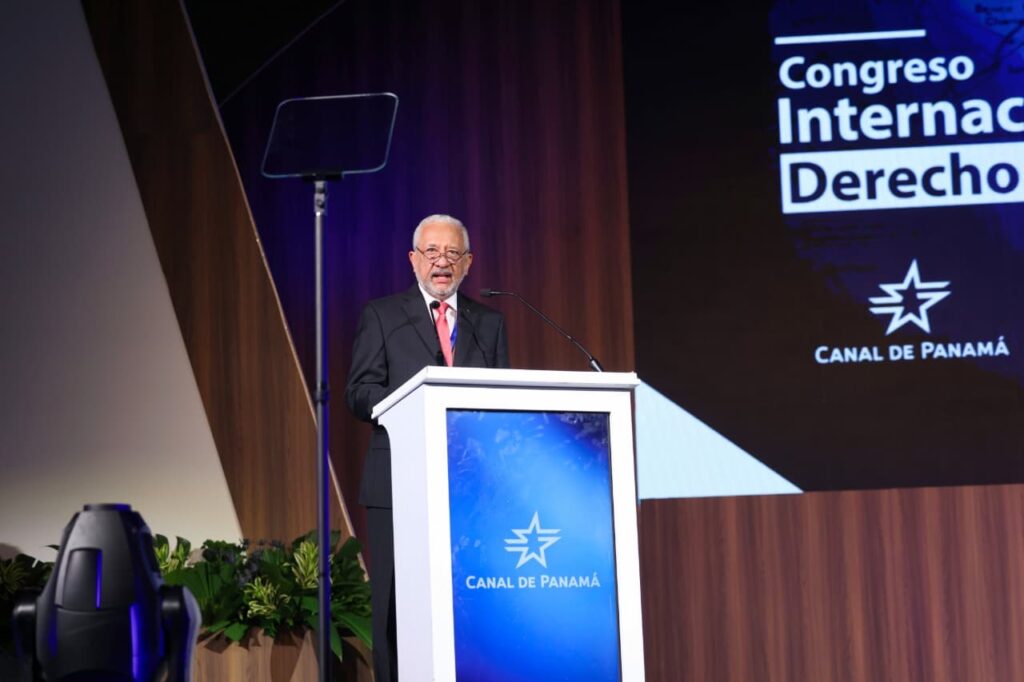
The Panama Canal officially opened the International Canal Law Congress, an academic and institutional forum with international scope aimed at analyzing and promoting the legal framework that underpins the operation of the interoceanic waterway. The opening day marked the start of two days of high-level technical exchange focused on the Neutrality Treaty, the Constitutional Title, and the Organic Law governing the institution.
During the inauguration, Panama Canal Administrator Ricaurte Vásquez Morales emphasized that the study of Canal Law is an essential task for both Panama and the legal community, as it is key to protecting and projecting the future of the Canal. He stressed that a deeper understanding of the Canal’s legal foundations helps strengthen national pride and long-term commitment to its preservation.
According to the Panama Canal Authority, the congress brings together jurists, academics, public officials, and national and international specialists to examine the Canal’s legal foundations from multiple perspectives, as well as contemporary issues related to governance, sustainability, and its role in the global environment. The opening ceremony was attended by Minister for Canal Affairs José Ramón Icaza, Supreme Court magistrates, members of the National Assembly, cabinet members, and other national and local authorities.
Throughout the agenda, panels and presentations are exploring the evolution of the Canal’s legal regime, its practical application, and its continued relevance in the face of new realities in trade and geopolitics. In this context, Agenor Correa, Vice President for Legal Counsel at the Canal, presented the conceptual framework of Canal Law, addressing its development as a discipline and its role in shaping the institutional structure that supports Canal operations.
From an international perspective, Oona Hathaway of Yale University and Kal Raustiala of UCLA examined the Neutrality Treaty, its enforcement mechanisms, and the way international law supports the Canal’s legal regime and global function. The program also included an academic discussion on the legal structure of the Panama Canal’s Constitutional Title, featuring leading Panamanian legal scholars such as Jorge Eduardo Ritter, Alfredo Ramírez Jr., Miguel Antonio Bernal, and Rigoberto González.
The two-day event is intended to generate input that contributes to institutional strengthening and the preservation of the principles that guarantee the neutral, efficient, and secure operation of the Panama Canal. Through this initiative, the Canal reinforces its commitment to promoting knowledge, transparency, and specialized dialogue by bringing together key voices to reflect on the legal framework that supports one of the world’s most strategic maritime routes.